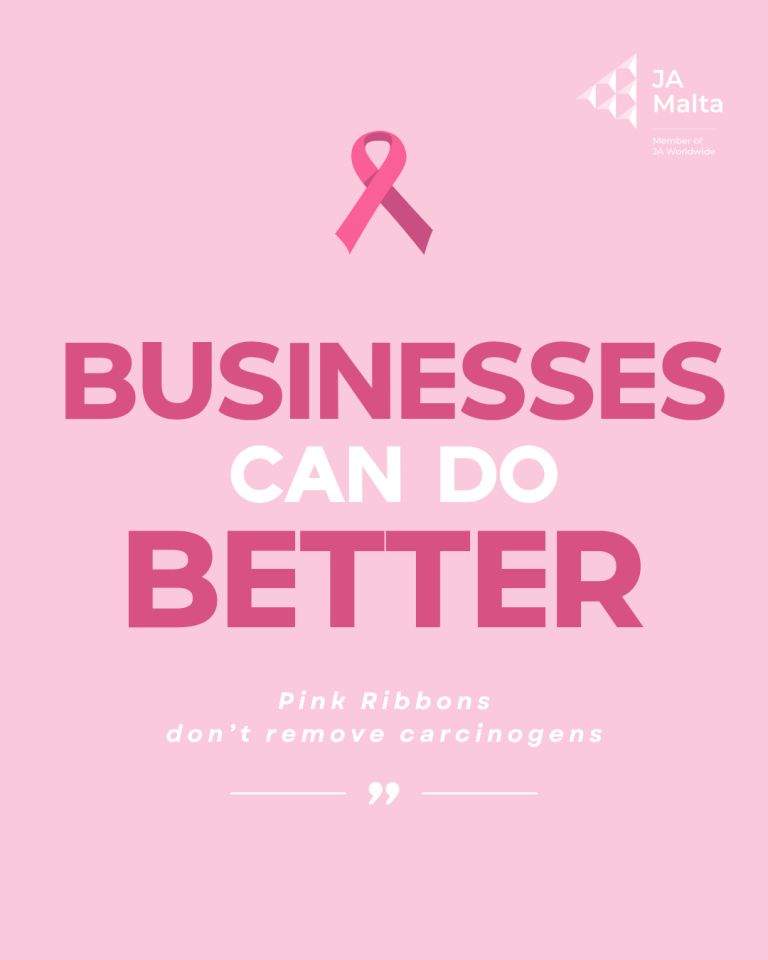
Every October, our digital feeds, shop windows, and storefronts explode in pink. Brands launch their pink collections, swap their logos for ribbons, and flash 10% is donated to breast cancer research.
The intention is in most cases very solid, awareness is needed and we should all show solidarity.. but all too often it all ends up being an illusion, cause it is not enough. In fact, many of those companies continue selling products loaded with chemicals linked to breast cancer risk.
Think you heard about greenwashing… well, add another term to the list, cause this is the core of pinkwashing:
Commodifying a cause while preserving the harms.
In other words, pinkwashing is when a business markets itself as pro breast cancer awareness through pink products or ribbon logos, while continuing harmful practices behind the scenes. These pink campaigns often end up oversimplifying the problem and diverting attention from structural change, while prioritising marketing over impact.
Because no… Pink ribbons don’t remove carcinogens.
The science we can’t ignore
Recent studies have flagged over 900 chemicals found in everyday consumer products that display breast cancer promoting traits. Substances like phthalates, BPA, solvents, endocrine disruptors and certain persistent chemicals (PFAS, dioxins, heavy metals) show up in plastics, cosmetics, cleaning agents, pesticides .. and now even our bodies.
Raising awareness is necessary, but not sufficient as such. We need deeper commitments such as brands routinely auditing ingredients, banning known or suspected carcinogens, and adopting safer alternatives. Not to mention that especially for women’s health, many safety tests are male biased, limited, or failing to account for hormonal cycles and diseases specific to women remain underresearched.
As such, entrepreneurs and startups of today and tomorrow have a role to play and to build products that don’t just market pink but are inherently safer.
In fact, at JA Malta, we nurture tomorrow’s entrepreneurs, and innovators to believe that business can and must be a force for good. In our programmes, notably the Company Programme (known as Young Enterprise), students are encouraged to think beyond profits and include environmental, health, and social impact while formulating their business plans. At JA, we want to catalyse ideas not just for green or pink branding, but for real change.
This stems from our belief in education as the first line of prevention, not only for diseases but for the systems that enable it. As such, we teach the youth we encounter to build companies with purpose at their core, so they begin to reimagine what success looks like, and they understand that profit can never come at the expense of people’s health or the planet’s wellbeing altogether.
Through our programmes we also guide the young generation to recognise their power; the power to question what’s on a label, to innovate safer formulas, to create transparent supply chains, and eventually to perhaps build businesses that place ethics before aesthetics.
Effectively, the fight against breast cancer is not just medical, its cultural, social and economic. Behind every purchasing decision, every product design and every business value matters, as it is the same innovation that can build a startup that can also build healthier alternatives for women.
So this Pinktober, JA Malta is going beyond awareness and asking for accountability.
To businesses, it’s time to choose better and offer better. Every product placed on a shelf, every ingredient approved, and every marketing choice made carries weight. The real show of solidarity isn’t in a ribbon but in a reformulated product, and a commitment to removing the silent toxins that harm the very women who make up most of your customer base.
To upcoming entrepreneurs: you have the power to reshape the story. Innovation doesn’t have to come wrapped in pink; it can come in safer alternatives, and ethical designs. Remember, you are not too small to set new standards. The companies you build today can define what responsible business looks like tomorrow.
And to policymakers, investors, and all stakeholders: it’s time to take women’s health seriously… not just in October, not just in campaigns, but in every investment and decision that shape our economy.
Last but surely not least, to all women reading this: your health is not an afterthought. Please go get checked, and encourage your friends, sisters, and colleagues to do the same.